Write an AI tools line you can actually test

A candidate reads "regular use of AI tools" and asks what good looks like. Your interviewer asks the same question. If neither of you has an answer, the line cannot help you hire.
Give the line a job: show how this engineer will work. Then use the interview to hear that work in a real example. A useful line has three parts: the task, the checking habit and the decision the engineer owns.
Start with the judgement, not the tools
A generated answer can look complete and still miss the risk that matters. The senior engineer supplies the judgement.
Senior work starts after the suggestion arrives. The engineer checks the assumption behind it. They look for a missed failure case. They inspect the tests, permissions and data access. They read the diff with the same care they would give a colleague's work.
This gives you something concrete to assess: what the engineer delegates, what they verify and where they stop.
Ground that assessment in a real task. Take one responsibility from the job ad. Then name the judgement that protects its quality. For a service API, that could mean checking failure handling and access rules. For an incident change, it could mean testing the fix before anyone trusts it.
A strong line names the work and the standard
A list of product names can hide the lack of a standard. Familiarity is not judgement. A tool list also ties your requirement to products that may change while the work stays the same.
The sample lines below are original examples, not lines copied from a job ad.
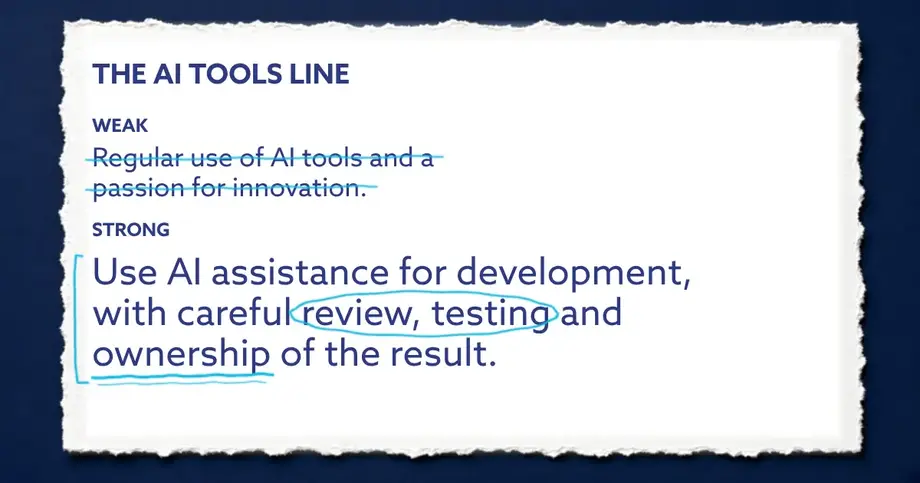
Weak sample wording: "Regular use of AI tools and a passion for innovation."
You cannot tell whether the candidate will protect quality, or merely accept a plausible answer.
Strong sample wording: "Use AI assistance to draft code or investigate problems, and take responsibility for reviewing the output, testing the changes and explaining your technical decisions."
The second line names a use, a checking habit and an ownership standard. A candidate can respond with evidence. Your interviewer can probe the same points.
A shorter option for the requirements list: "Use AI assistance for development, with careful review, testing and ownership of the result."
Keep tool names out unless one is essential to the role. If it is, say what the engineer must be able to do with it. Name the work before the product.
Seniority means other people can learn from you
A useful personal habit is only part of the senior job. The senior engineer also helps a team use AI with care.
One dated example gets this right. A Senior Golang Engineer job ad published on 14 September 2026 asks for "Regular and responsible use of AI tools to improve productivity and quality of outcomes, and the ability to guide others in doing the same."
The last clause matters. "Guide others" turns private tool use into a shared engineering practice.
Add that expectation when the role calls for it. Original sample wording: "Help other engineers review AI-assisted changes, test the output and raise concerns about quality, security or maintainability."
That is a coaching standard you can observe in a review, not a request to promote a product.
Ask questions that uncover judgement
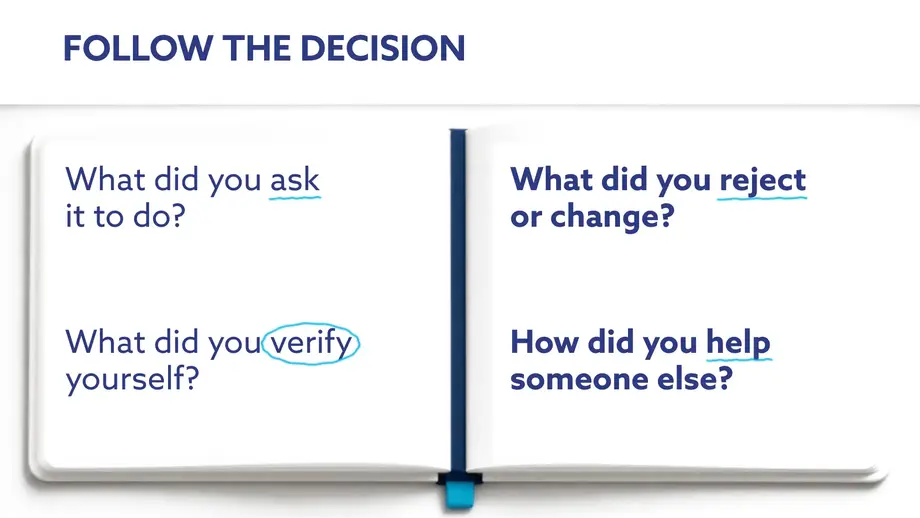
Skip "How do you use AI?" It invites a tour of features. Ask for one piece of work, then follow the decisions.
- Start: "Tell me about an AI-assisted change you made. What did you ask it to do?"
- Check: "Which part did you verify yourself, and how?"
- Challenge: "What did you reject or change, and why?"
- Senior follow-up: "How did you help someone else improve the way they used the tool?"
The first answer only sets the scene. The useful evidence comes when you ask what happened next.
Listen for the decision behind the answer
The sample answers below are original illustrations, not candidate quotes.
A weak answer sounds confident but stays at the level of enthusiasm: "I use AI every day to write code faster. It saves me a lot of time."
The answer gives you no quality evidence. Ask for a specific change and the checking that followed.
A strong answer sounds more like this: "I used it to sketch an API change. It suggested a retry loop, but I found that repeated requests could create duplicate work. I changed the approach and added a test for that case before asking for review."
You now have a task, a concern, a decision and a check. Notice what is missing: a claim that AI made the work faster. The useful evidence is how the engineer protected the result.
A strong senior answer adds a team example: "A colleague accepted a generated migration without checking how it handled existing records. I reviewed the rollback path with them and added that check to our review guide."
The signal is not a polished story. It is the engineer's ability to explain a choice and improve somebody else's next choice.
Remove the traps before you publish
Check whether the line rewards hype. "AI-first mindset" can sound like confidence is more valuable than care. Prefer an observable habit, such as reviewing output and testing a change.
Check whether the line hides behind novelty. "Passion for the latest AI tools" says nothing about how the engineer works on your systems.
Check the scale of the demand. "Expert in all AI coding tools" asks for breadth without telling you what good work looks like.
Finally, check your own interview. If you cannot name the evidence you want, the candidate cannot know what good looks like.
Put the finished line beside the job
Read the requirement beside the matching responsibility. The connection should be obvious without a speech about innovation.
Original sample pairing:
- Responsibility: "Design and deliver reliable backend services."
- Requirement: "Use AI assistance to explore implementation options, then review, test and own the changes you ship."
Then give the interviewer a prompt that tests the actual requirement: "Walk me through the last AI-assisted change you shipped. Which checks did you keep for yourself?"
That is enough to make the line useful to all three readers. The hiring manager can defend it. The interviewer can test it. The senior engineer can see the standard and decide whether the role fits.
If you want a second pair of eyes on the requirement and the interview prompts, bring them to Human Direct.
Share this article on
Introducing the developer’s
console.
Sign up to our newsletter and you will receive periodic updates of new blog posts, contests, events and job opportunities.
From our blog
Get insight. Articles
we like and you may, too.
-

How to write a tech job ad senior engineers answer
A job ad that senior engineers answer names the work, separates what is required from what would be nice, and says what the engineer gains. This guide shows each step with lines...
Read blog post -> -

How to win experienced engineers in Romania's reshuffled market
Romania's IT sector grew in 2025 while firms reshuffled their teams, and experienced engineers moved with it. They are available but selective, and the employers who approach them...
Read blog post -> -

Recruiting Software Developers in Romania: Why It's a Strategic...
Looking to expand your tech team with top talent? Romania is quickly becoming a prime destination for IT recruitment, offering a rich pool of highly skilled developers. Partnering...
Read blog post ->